Gut Health 101: What Actually Works, What Doesn't, and Why It Starts With Food
What actually moves the needle on gut health — and what doesn't. A food-first guide backed by science, not supplement industry talking points.
Gut Health 101: What Actually Works, What Doesn't, and Why It Starts With Food
This post contains affiliate links. I only recommend products I've personally researched.
The Gut Is the Foundation — But Most People Are Chasing the Wrong Fix
There's a reason gut health has become one of the most researched areas in modern medicine. The gut microbiome — the 38 trillion microorganisms living in your digestive tract — influences everything from immune function and mental health to metabolic rate and chronic inflammation.
Most people learn this and immediately buy a probiotic supplement. That's the wrong first move.
The supplement industry has turned gut health into a $50 billion category. Most of what's being sold is premature at best and ineffective at worst. The science is real and fascinating — the products claiming to "fix" your gut are often not.
Here's what the evidence actually says.
What Your Gut Microbiome Actually Does
The gut microbiome is not a single organism — it's an ecosystem of bacteria, fungi, viruses, and archaea that has co-evolved with humans for millennia. A healthy microbiome:
- Produces short-chain fatty acids (SCFAs) that fuel colon cells and reduce systemic inflammation
- Synthesizes vitamins B12, K2, and several B vitamins
- Trains and modulates the immune system (70–80% of your immune tissue is in your gut)
- Produces neurotransmitters — roughly 90% of your serotonin is produced in the gut
- Metabolizes bile acids and influences cholesterol
- Protects against pathogenic bacteria by competitive exclusion
When the microbiome is disrupted — through antibiotics, chronic stress, highly processed food, or lack of dietary diversity — the downstream effects reach every system in the body.
What Actually Disrupts Gut Health
Before you can fix something, understand what's breaking it.
1. Ultra-processed food
The #1 driver of gut microbiome disruption in Western populations. Emulsifiers (carrageenan, polysorbate-80, carboxymethylcellulose) in processed foods have been shown in animal and human studies to disrupt the gut's mucus lining and promote low-grade inflammation. Artificial sweeteners alter microbiome composition in multiple human trials.
2. Antibiotics
Necessary and life-saving when needed — but each course of antibiotics can eliminate hundreds of bacterial species, and recovery to baseline can take months to years. This isn't a reason to avoid antibiotics when they're required, but it is a reason to be intentional about restoration afterward.
3. Chronic stress
The gut-brain axis is bidirectional and very real. Chronic psychological stress alters gut motility, increases intestinal permeability ("leaky gut"), and changes microbiome composition toward more inflammatory species. This is why stress always shows up physically in the digestive system.
4. Lack of dietary fiber diversity
Modern Western diets average 10–15g of fiber per day. Ancestral diets contained 50–100g. Fiber is the primary fuel for beneficial bacteria — without it, populations of Bifidobacterium and Lactobacillus (the good guys) decline. Diversity of fiber sources matters as much as quantity — different fibers feed different bacterial species.
5. Insufficient sleep
Circadian rhythm disruption directly affects the gut microbiome's composition and metabolic activity. Shift workers consistently show altered microbiome profiles compared to day workers.
What the Evidence Says Actually Works
1. Dietary Fiber — The Foundation
This is not glamorous. You cannot supplement your way out of a low-fiber diet. Every study on microbiome diversity points back to fiber intake as the primary driver.
What to increase:
- Vegetables — especially prebiotic-rich ones: garlic, onion, leeks, asparagus, Jerusalem artichoke
- Legumes — beans, lentils, chickpeas
- Whole grains — oats (contain beta-glucans, same compounds as medicinal mushrooms), barley, rye
- Fruit — particularly berries, apples (pectin is a potent prebiotic)
- Mushrooms — particularly Oyster, Shiitake, and Reishi — contain beta-glucans that feed beneficial bacteria specifically
The goal is dietary diversity. Research by the American Gut Project found that eating 30+ different plants per week was the single strongest predictor of microbiome diversity — more predictive than whether someone was vegan, vegetarian, or omnivore.
2. Fermented Foods — Better Than Probiotic Supplements
A 2021 Stanford study (Wastyk et al.) randomized participants to either a high-fiber diet or a high-fermented-food diet for 10 weeks. The fermented food group showed:
- Significantly increased microbiome diversity
- Decreased markers of systemic inflammation (19 inflammatory proteins decreased)
- These effects were NOT seen in the high-fiber group alone
Fermented foods with evidence:
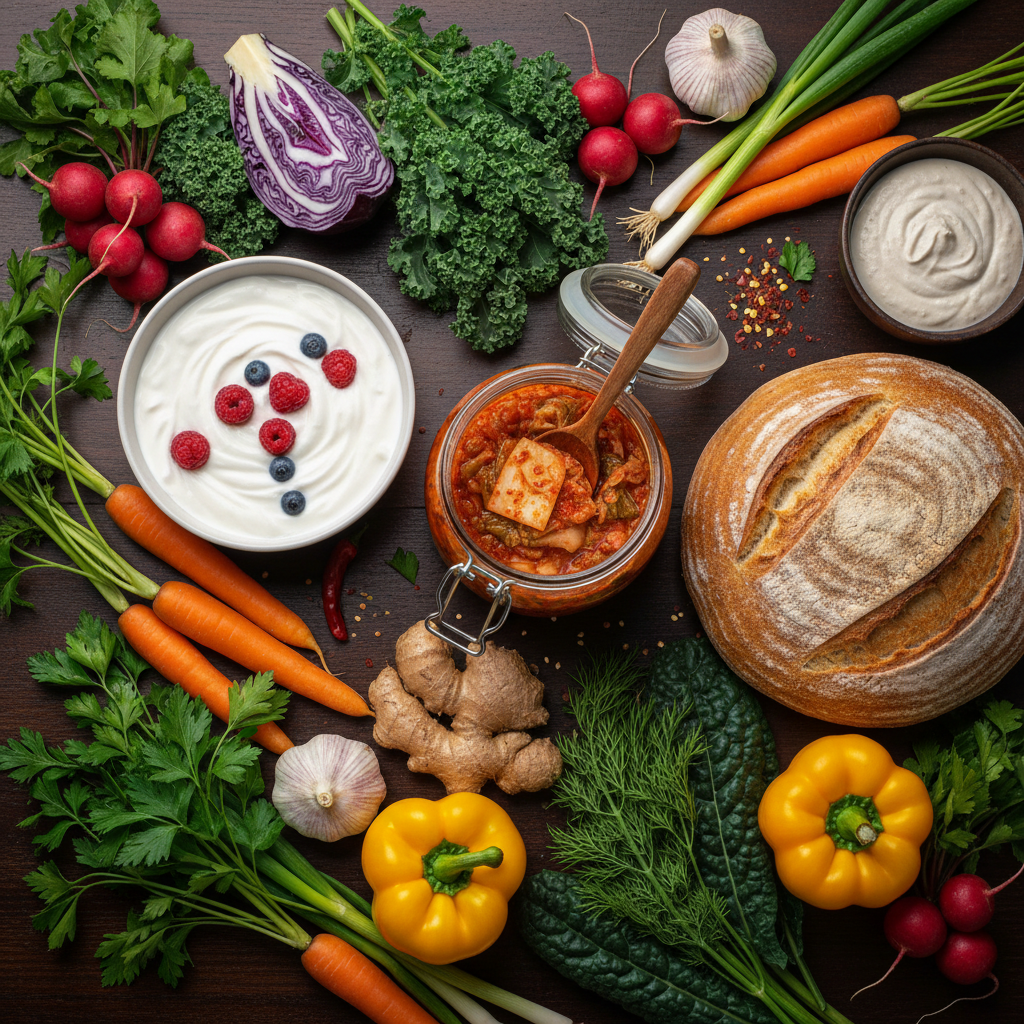
- Yogurt (with live cultures — check the label)
- Kefir — higher bacterial diversity than yogurt, well-tolerated even by many lactose-intolerant people
- Sauerkraut — raw, unpasteurized (pasteurization kills the cultures)
- Kimchi — highest bacterial diversity of common fermented foods
- Miso — fermented soybean paste
- Kombucha — moderate evidence, variable quality between brands
3. Prebiotics
Prebiotics are food for beneficial bacteria — specifically non-digestible fibers that selectively fuel Bifidobacterium and Lactobacillus species.
Most studied prebiotics:
- Inulin — found in chicory root, garlic, onions. Most extensively researched.
- FOS (Fructooligosaccharides) — found in asparagus, bananas, leeks
- GOS (Galactooligosaccharides) — found in legumes, some dairy
- Beta-glucans — found in oats, barley, and medicinal mushrooms
Garden of Life's Raw Probiotics and Thorne's FiberMend are both solid prebiotic/probiotic combination supplements — but only as a complement to dietary changes, not a replacement.
4. Probiotic Supplements — When They Help (and When They Don't)
Here's the honest breakdown on probiotic supplements:
Where probiotics have good evidence:
- During and after antibiotic treatment (specifically Lactobacillus rhamnosus GG and Saccharomyces boulardii)
- Irritable Bowel Syndrome — moderate evidence for symptom reduction
- Antibiotic-associated diarrhea prevention
- Some evidence for eczema prevention in infants
Where probiotics have weak or no evidence:
- Healthy people with good diet wanting general "gut health improvement"
- Most of the conditions broadly marketed (immunity, mental health, weight loss)
The problem: most commercial probiotics don't survive stomach acid in meaningful quantities. Enteric-coated capsules or spore-forming strains (Bacillus coagulans, Bacillus subtilis) have better survival rates. And the gut microbiome is so individual that a probiotic that helps one person may have no effect on another.
If you're going to use a probiotic supplement:
- Look for strains specified to genus and species level (Lactobacillus rhamnosus GG, not just "Lactobacillus")
- Minimum 10–50 billion CFU
- Third-party tested for viability at time of consumption (not just at manufacture)
- Garden of Life RAW Probiotics meets all of these criteria
Mushrooms and Gut Health
This is worth its own section because it connects to what we grow at Hidden Springs Forest.
Beta-glucans — the primary bioactive compounds in medicinal mushrooms (and in oats and barley) — function as prebiotics. They selectively increase Bifidobacterium and Lactobacillus populations in the colon, reduce intestinal inflammation, and strengthen the gut mucosal barrier.
A 2021 study found that Oyster mushroom beta-glucans significantly increased beneficial bacteria and reduced inflammatory markers in participants with gut inflammation.
Practical implication: eating fresh Oyster, Shiitake, or Lion's Mane mushrooms regularly provides a meaningful prebiotic effect that most people aren't accounting for. Growing your own or buying fresh from a local farm gets you the most beta-glucan-rich product available.
For supplemental beta-glucans, Real Mushrooms publishes COAs showing beta-glucan content on every product — the only supplement brand I can say that about with confidence.
A Realistic Gut Health Protocol
Foundation (non-negotiable):
- 30+ different plant foods per week
- 2–3 servings of fermented food daily
- 7–9 hours of sleep
- Stress management (the gut-brain axis is real)
- Filtered water (chlorine disrupts microbiome)
Supplements that add value on top of the foundation:
- Prebiotic fiber supplement if dietary intake is consistently low (Thorne FiberMend)
- Probiotic during/after antibiotics (Jarrow Formulas, Garden of Life)
- Mushroom beta-glucans (Real Mushrooms or fresh cultivated)
Skip:
- Expensive "gut reset" programs
- Cleanses and detoxes (your liver and kidneys do this — they don't need help)
- Any product making specific disease treatment claims
What I Eat Every Day for Gut Health
I live on 30 acres and grow a significant portion of my own food. My non-negotiables:
- Fresh mushrooms (Lion's Mane or Oyster) at least 4x/week
- Homemade sauerkraut — dead simple to make, highest bacterial count of any fermented food
- Daily prebiotic load from garlic, onion, and legumes
- Organifi Green Juice for superfoods on days when diet falls short — USDA Organic, glyphosate-free
The gut responds to consistency more than any single intervention. The ecosystem takes months to shift. Give it the inputs it needs, every day, and it rebuilds itself.
Fungi For Life LLC · Justin Hagan · Hidden Springs Forest, Strasburg, Illinois
This post contains affiliate links. See our full FTC Disclosure and Privacy Policy for details.
📚 Related Reading: Lion's Mane Mushroom Benefits · Adaptogens 101 · How to Detox Your Home