Lion's Mane Mushroom Benefits: What the Science Actually Says
What peer-reviewed science actually says about Lion's Mane — NGF stimulation, cognitive benefits, and how to choose a supplement that works.
Lion's Mane Mushroom Benefits: What the Science Actually Says
This post contains affiliate links. If you purchase through my links, I may earn a commission at no extra cost to you. I only recommend products I've personally researched and believe in.
The Mushroom Everyone Is Talking About — But Few People Understand
Lion's Mane (Hericium erinaceus) has exploded into mainstream wellness culture. You'll find it in coffee, supplements, tinctures, gummies, and face serums. Every brand claims it "boosts brain function" and "supports cognitive health."
Most of them are selling you mycelium grown on oats with trace amounts of the actual active compounds.
Here's what the peer-reviewed science actually says about Lion's Mane — what it does, what it doesn't do, what the real research shows, and how to make sure you're buying a product that actually contains what it claims.
I grow Lion's Mane at Hidden Springs Forest in Strasburg, Illinois. I've read the studies. I've grown the mushroom. This is an honest breakdown.
What Is Lion's Mane?
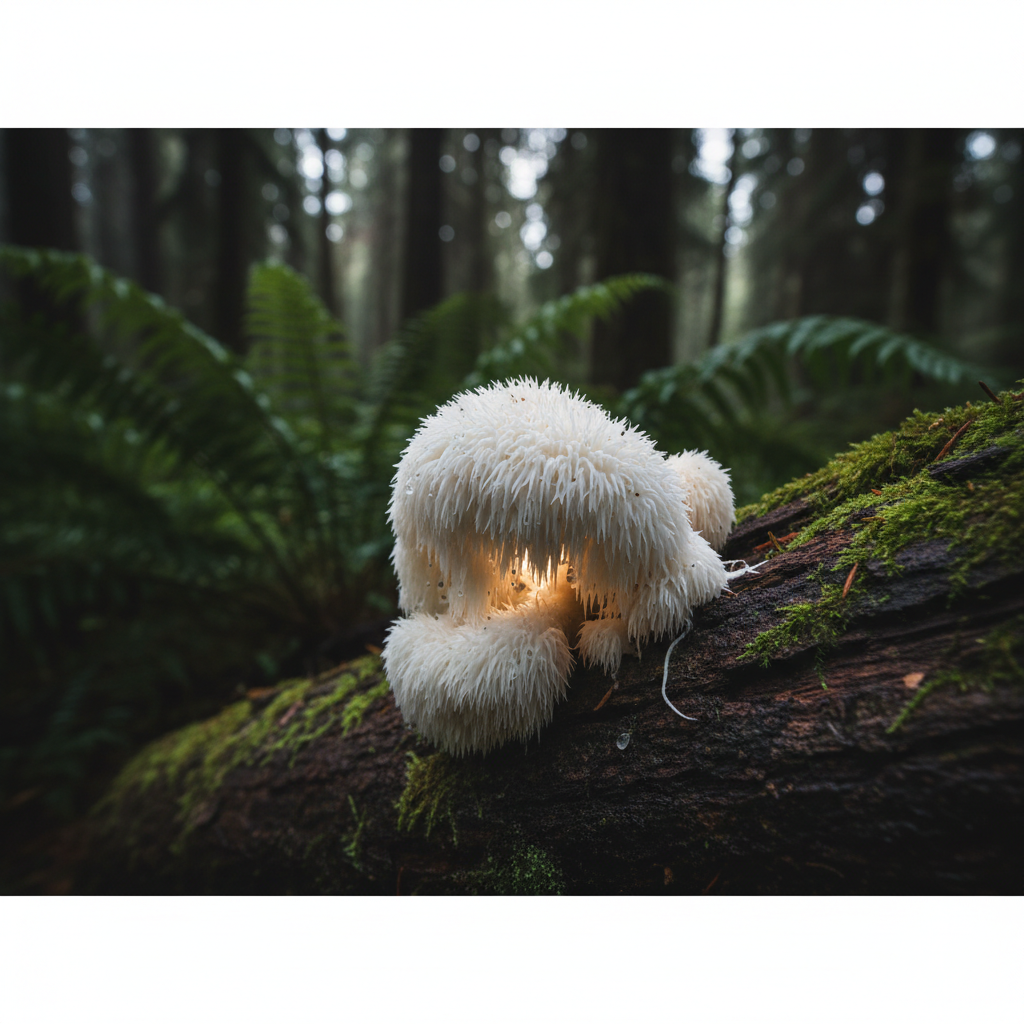
Hericium erinaceus is a medicinal and culinary mushroom native to North America, Europe, and Asia. It grows on dead or dying hardwood trees — oak, beech, maple — and looks unlike any other mushroom: white, cascading, resembling a lion's mane or a waterfall of icicles.
It has been used in Traditional Chinese Medicine for centuries, primarily for digestive support and cognitive enhancement. Modern research has been investigating whether those traditional uses hold up to scientific scrutiny.
The short answer: some of them do, quite compellingly. Others remain preliminary. The honest breakdown follows.
The Key Compounds
Two classes of compounds in Lion's Mane are responsible for most of its studied effects:
Hericenones — found in the fruiting body (the actual mushroom). Hericenones are small lipophilic molecules that can cross the blood-brain barrier and have been shown in laboratory studies to stimulate Nerve Growth Factor (NGF) synthesis.
Erinacines — found primarily in the mycelium. Erinacines are diterpene compounds that also stimulate NGF synthesis and have shown neuroprotective effects in animal studies.
This is important context for the supplement industry debate: both fruiting body AND mycelium contain relevant compounds — but they contain different compounds. A fruiting body extract is not superior or inferior in a blanket sense — it depends on what you're trying to get. The problem with most commercial mycelium-on-grain supplements isn't that mycelium is bad — it's that the grain substrate dilutes the actual mycelium to the point where the beta-glucan and erinacine content is negligible.
Real Mushrooms published their third-party lab tests showing competitors' "mycelium" products were 50-80% starch. That's the problem.
The Research — What Studies Actually Show
1. Nerve Growth Factor Stimulation
Study: Mori et al. (2008) — Nerve Growth Factor-Inducing Activity of Hericium erinaceus in 1321N1 Human Astrocytoma Cells
This foundational study demonstrated that hericenones extracted from Lion's Mane fruiting body stimulate NGF synthesis in human cell lines. NGF is critical for the growth, maintenance, and survival of neurons — particularly in the hippocampus and cerebral cortex, regions involved in memory and learning.
What this means in plain language: Lion's Mane compounds can tell your brain cells to produce more of the protein responsible for keeping those cells alive and functional.
Limitation: This was an in vitro (cell culture) study. Cell culture results don't always translate directly to human clinical outcomes.
2. Cognitive Function in Older Adults
Study: Mori et al. (2009) — Improving Effects of the Mushroom Yamabushitake (Hericium erinaceus) on Mild Cognitive Impairment: A Double-Blind Placebo-Controlled Clinical Trial
Published in: Phytotherapy Research
This is the most cited human clinical trial on Lion's Mane. 30 Japanese men and women aged 50–80 with mild cognitive impairment were randomized to receive either 3g/day of Lion's Mane powder or placebo for 16 weeks.
Results: The Lion's Mane group showed significantly higher scores on the cognitive function scale at weeks 8, 12, and 16 compared to placebo. Cognitive scores decreased after supplementation stopped, suggesting the effect was dependent on continued use.
What this means: In a small but legitimate double-blind clinical trial, Lion's Mane supplementation measurably improved cognitive function in older adults with mild impairment.
Limitation: Small sample size (n=30). Japanese population. Used whole mushroom powder, not standardized extract. Needs replication in larger, more diverse populations.
3. Anxiety and Depression
Study: Nagano et al. (2010) — Reduction of Depression and Anxiety by 4 Weeks of Hericium erinaceus Intake
Published in: Biomedical Research
30 menopausal women were randomized to consume Lion's Mane cookies or placebo cookies for 4 weeks. Women in the Lion's Mane group reported significant reductions in self-reported anxiety and depression compared to placebo.
What this means: Lion's Mane may have genuine anxiolytic (anxiety-reducing) effects, possibly mediated through NGF support of serotonergic neurons or through direct anti-inflammatory effects.
Limitation: Small sample, self-reported outcomes, short duration. But the finding aligns with animal studies showing antidepressant-like effects.
4. Neuroprotection and Alzheimer's Research
Multiple animal studies have shown Lion's Mane extracts reduce amyloid-beta plaque formation (a hallmark of Alzheimer's disease) and improve cognitive performance in rodent models of Alzheimer's.
Key study: Zhang et al. (2016) — The Neuroprotective Properties of Hericium erinaceus in Glutamate-Damaged Differentiated PC12 Cells
What this means: There is legitimate preclinical evidence that Lion's Mane compounds protect neurons from damage and may reduce Alzheimer's-related pathology.
Limitation: Animal and cell studies. No completed large-scale human clinical trials on Alzheimer's prevention or treatment. This area is promising but not proven in humans.
5. Immune System Support
Study: Kim et al. (2013) — Hericium erinaceus Suppresses LPS-Induced Pro-Inflammatory Responses Through TLR4-Mediated Signaling Pathways
Lion's Mane beta-glucans have demonstrated anti-inflammatory and immunomodulatory effects — reducing inflammatory cytokines and modulating immune response in cell and animal studies.
What this means: The beta-glucan content of genuine Lion's Mane extracts (not grain-diluted supplements) has real immune-supportive properties. This is why beta-glucan content is the primary quality marker to look for on lab certificates.
What the Science Does NOT Prove
To be honest — because that's the only way I can recommend anything in good conscience:
- No large-scale RCTs in healthy adults. Most human trials are small and conducted in people with existing cognitive impairment or specific health conditions.
- No proven cure or treatment for Alzheimer's, dementia, or any neurodegenerative disease. Any brand making these claims is violating FDA regulations.
- No established optimal dose. Studies have used 3–5g/day of whole mushroom powder. Extract dosing varies significantly by concentration.
- Effects appear to require continued supplementation. The 2009 Mori study showed cognitive scores returned to baseline after stopping. This is not a one-time fix.
How to Consume Lion's Mane
Fresh (culinary): The most bioavailable form. Lion's Mane has a mild, seafood-like flavor — often compared to crab or lobster when sautéed in butter. Slice thick, cook on medium-high heat until golden. Excellent on its own, in pasta, or as a meat substitute.
Dried: 10x concentrated compared to fresh. Grind into powder and add to coffee, tea, smoothies. 1–2g/day as a general wellness dose.
Dual-extracted tincture: Hot water extraction releases beta-glucans (water-soluble). Alcohol extraction releases hericenones and erinacines (fat-soluble). A dual-extracted tincture captures both. This is the most potent supplemental form.
Capsules/powder: Convenient but quality varies enormously. See below.
How to Buy Quality — What to Actually Look For
This is where 90% of people get ripped off.
Look for:
- ✅ 100% fruiting body — no mycelium on grain
- ✅ Beta-glucan percentage listed — minimum 20%, preferably 30%+
- ✅ Third-party Certificate of Analysis (COA) — published on the product page
- ✅ USDA Organic or equivalent certification
- ✅ No starch/filler listed in COA
Red flags:
- ❌ "Mycelium biomass" without starch testing
- ❌ No COA available
- ❌ Beta-glucan content not listed
- ❌ Proprietary blends that hide individual amounts
What I recommend:
Real Mushrooms Lion's Mane — 100% fruiting body, USDA Organic, NSF audited, COA published on every product page, ConsumerLab award winner. This is the only brand I can point to and say with confidence: what's on the label is in the bottle.
North Spore — if you want to grow your own. Lion's Mane spawn, organic grow kits, expert-level support. Growing your own gives you the freshest, most potent product available at any price point.
Growing Your Own Lion's Mane
This is the path I've taken at Hidden Springs Forest — and for anyone serious about quality and cost control, it's the best option.
What you need:
- Lion's Mane grain spawn or plug spawn (North Spore)
- Hardwood sawdust substrate (oak/beech preferred)
- Fruiting chamber or grow tent
- 60–70°F fruiting temperature (cooler than oysters)
- High humidity: 90–95%
Yield: A properly colonized block will produce 150–250g per flush, 2–3 flushes per block. At $16/lb fresh market value, one block cycle returns $5–8 in product from $2–3 in supplies.
The real value: You know exactly what you grew, how it was grown, and what's in it. No supply chain. No labeling games. Pure fruiting body, fresh.
Bottom Line
Lion's Mane is one of the most researched medicinal mushrooms in existence. The evidence for cognitive support, NGF stimulation, and neuroprotection is genuinely compelling — not hype. The studies are real, peer-reviewed, and published in legitimate journals.
The supplement industry has capitalized on that research to sell low-quality products that contain mostly grain with trace amounts of actual mycelium.
Buy from companies that publish their lab results. Better yet, grow your own.
The science is real. Most of the products aren't.
Want to grow Lion's Mane yourself? I've put together a full cultivation guide here → How to Start a Mushroom Farm Business
For ready-made supplements I've personally vetted, I recommend Real Mushrooms — the only brand I trust enough to link to.
Sources:
- Mori et al. (2008). Nerve Growth Factor-Inducing Activity of Hericium erinaceus. Int J Med Mushrooms.
- Mori et al. (2009). Improving Effects of Yamabushitake on Mild Cognitive Impairment. Phytotherapy Research.
- Nagano et al. (2010). Reduction of Depression and Anxiety by Hericium erinaceus Intake. Biomedical Research.
- Zhang et al. (2016). Neuroprotective Properties of Hericium erinaceus. Evidence-Based Complementary Medicine.
- Kim et al. (2013). Hericium erinaceus Suppresses LPS-Induced Pro-Inflammatory Responses. Food & Chemical Toxicology.
Fungi For Life LLC · Justin Hagan · Hidden Springs Forest, Strasburg, Illinois
This post contains affiliate links. See our full FTC Disclosure and Privacy Policy for details.
📚 Related Reading: Adaptogens 101 · Mushroom Coffee: Legit or Hype? · Gut Health 101