Grow Your First Mushrooms at Home: A Beginner's Complete Guide
A complete beginner's guide to growing gourmet mushrooms at home — from choosing your first species to harvesting your first flush.
Grow Your First Mushrooms at Home: A Beginner's Complete Guide
Affiliate Disclosure: This post contains affiliate links. If you purchase through our links, we may earn a commission at no extra cost to you. We only recommend products we personally use and trust.
Growing mushrooms at home is easier than most people think — and more rewarding than almost any other hobby you can do in a small space. Within a few weeks of starting, you can be harvesting fresh oyster mushrooms, lion's mane, or shiitake from a corner of your kitchen, garage, or basement.
This guide covers everything a beginner needs to get started, from choosing your species to troubleshooting your first grow.
Why Grow Mushrooms at Home?
A few reasons this hobby has exploded in popularity:
- Economics: A $30 grow kit can produce $60–100 worth of fresh mushrooms over multiple flushes
- Health: Fresh-harvested mushrooms contain significantly higher beta-glucan and antioxidant content than store-bought
- Fascination: Once you understand mycelium, you can't stop thinking about it
- Sustainability: Mushrooms grow on agricultural waste — straw, sawdust, coffee grounds — turning "trash" into food
Best Mushrooms for Beginners
Not all mushrooms are equal in terms of cultivation difficulty. Start here:
1. Oyster Mushrooms (Pleurotus spp.) — Easiest
Oysters are the beginner's best friend. They colonize fast, fruit aggressively, and tolerate imperfect conditions better than any other gourmet species. They'll grow on straw, cardboard, coffee grounds, or hardwood sawdust.
Varieties to try:
- Pearl Oyster — most common, mild flavor
- Blue Oyster — slightly faster, slightly more cold-tolerant
- Pink Oyster — tropical, stunning color, fast fruiting
- Golden Oyster — delicate, nutty flavor
2. Lion's Mane (Hericium erinaceus) — Beginner-Intermediate
Lion's mane grows as a cascading white pom-pom and is one of the most researched mushrooms for brain health — specifically NGF (nerve growth factor) stimulation. It's a bit more finicky than oysters but still very achievable at home on hardwood sawdust blocks.
3. Shiitake (Lentinula edodes) — Intermediate
Shiitake takes longer to colonize (60–90 days on hardwood logs) but rewards patience with multiple years of harvests from the same log. Rich, umami flavor. Strong immune-supporting beta-glucan profile.
What You Need to Get Started
Option A: Grow Kit (Easiest)
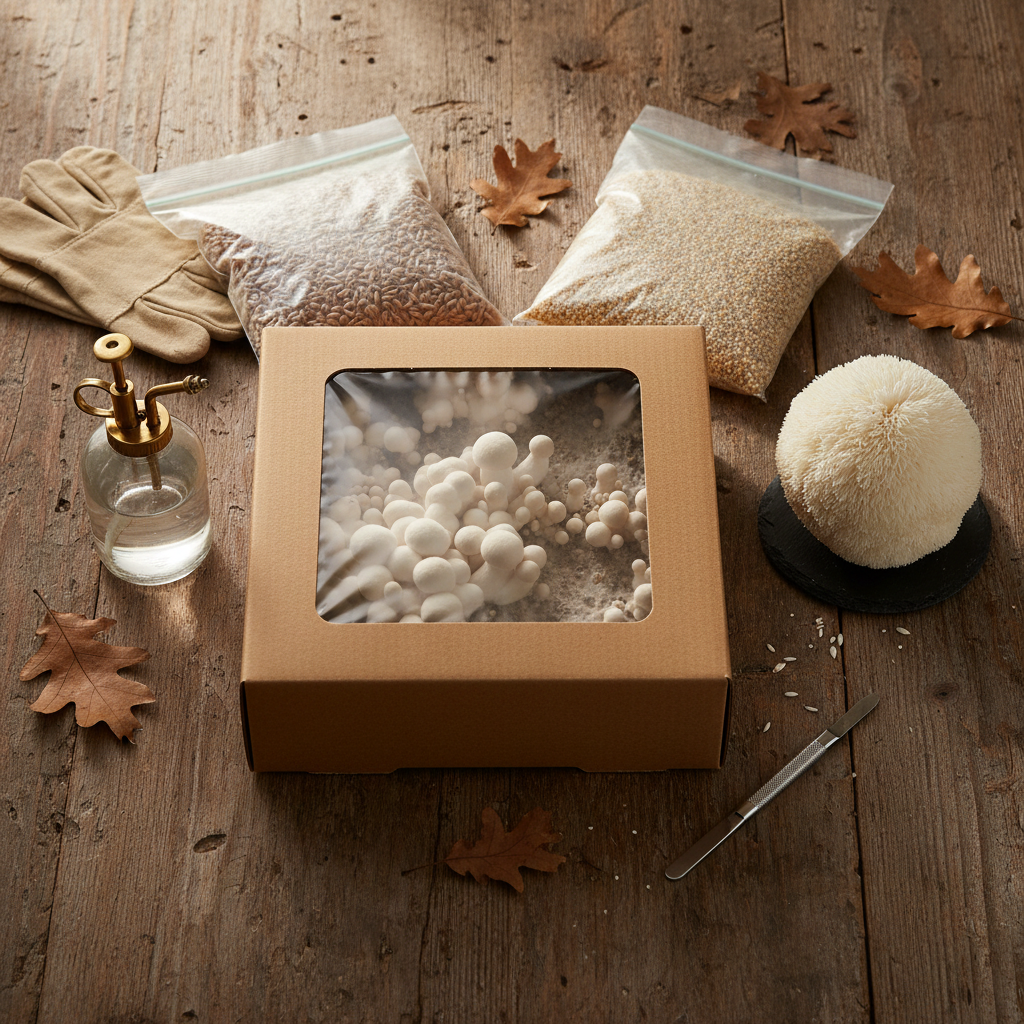
A ready-to-fruit mushroom grow kit is the fastest path from zero to harvest. The substrate is already colonized — you just need to trigger fruiting by:
- Cutting an X in the bag
- Misting 2–3x daily
- Keeping in indirect light at 65–75°F
North Spore's grow kits are our top recommendation — USDA Organic certified, fully colonized, and shipped with clear instructions. Most people see pins (baby mushrooms) within 5–7 days.
Option B: Spawn + Substrate (More Control)
If you want to learn the full process and scale up, you'll need:
- Spawn — mushroom mycelium grown on grain or sawdust
- Substrate — the material the mycelium colonizes (straw, hardwood sawdust, etc.)
- Containers — buckets, bags, or logs depending on species
- Basic sterile technique — gloves, clean workspace, optionally a still air box
North Spore carries grain spawn and sawdust spawn for all major species, as well as pre-pasteurized substrate bags that eliminate most of the prep work.
The Mushroom Life Cycle (Simplified)
Understanding this helps you troubleshoot problems before they happen.
Inoculation → Colonization → Fruiting → Harvest
- Inoculation: Spawn is introduced to substrate
- Colonization: White mycelium spreads through the substrate (days to weeks depending on species and temperature)
- Fruiting trigger: A change in conditions — temperature drop, fresh air exchange, light, moisture — signals the mycelium to produce fruiting bodies
- Pinning: Tiny mushroom primordia appear
- Development: Mushrooms grow rapidly — oysters can double in size overnight
- Harvest: Cut or twist mushrooms at the base before caps flatten and curl
- Second flush: Allow substrate to rest, then re-trigger for another harvest
Most species produce 2–4 flushes before the substrate is exhausted.
Growing Conditions by Species
| Species | Colonization Temp | Fruiting Temp | Humidity | Difficulty |
|---|---|---|---|---|
| Oyster | 70–75°F | 55–75°F | 85–95% | Easy |
| Lion's Mane | 70–75°F | 60–70°F | 85–95% | Medium |
| Shiitake | 70–75°F | 55–65°F | 85–90% | Medium |
| King Oyster | 70–75°F | 55–65°F | 85–90% | Medium |
Common Beginner Problems
Green or black mold contamination
The most common issue. Caused by unsterile technique or substrate that wasn't properly pasteurized. Discard contaminated blocks outdoors — never open them inside.
Mycelium not growing
Usually too cold, or spawn wasn't viable. Verify your temperature is in range and source fresh spawn.
Mushrooms aborting before maturity
Low humidity or poor fresh air exchange. Mist more frequently and ensure CO2 isn't building up in your grow space.
Caps turning brown or drying out
Too much direct airflow or low humidity. Mist the walls of your grow space rather than directly on the mushrooms.
Scaling Up: From Hobby to Farm
Many small mushroom farms started with a single grow kit on a kitchen counter. The path to scaling looks like this:
- Hobby: 1–3 grow kits, personal consumption
- Small production: 5–20 blocks, selling at farmers markets or to local restaurants
- Micro-farm: Dedicated grow space, temperature and humidity control, consistent weekly production
At the micro-farm level, a 10x10 grow room running efficiently can produce 50–100 lbs of fresh mushrooms per week — enough to generate meaningful income.
For those serious about scaling, North Spore's bulk supplies including bulk grain spawn, pre-made substrate, and professional grow bags offer the best value we've found for small-scale producers.
The Deeper Dimension
There's something that happens when you grow mushrooms that goes beyond the practical. You start to understand mycelium — the vast, interconnected fungal networks that decompose dead matter, build soil, and link trees in a forest into a living communication system.
Paul Stamets calls it the "wood wide web." The science is increasingly backing up what foragers and mycologists have understood for decades: fungi are not just food. They are infrastructure.
Growing mushrooms at home is, in a small way, participating in that system. You become a cultivator of something ancient and essential.
Start with one kit. See what happens.
Recommended products:
- North Spore Grow Kits — best beginner kits, USDA Organic
- Lion's Mane Supplements — Real Mushrooms, 100% fruiting body extract
Tags: grow mushrooms at home, mushroom cultivation beginner, oyster mushroom growing, lion's mane cultivation, mushroom grow kit, home mushroom farm
📚 Related Reading: Best Oyster Mushroom Substrate · Best Mushroom Growing Supplies · How to Find Morel Mushrooms